
A purple Victorian house on Ashbury Street sells for $1.4 million today and it once held five broke musicians who couldn’t cover the rent. That house belonged to the Grateful Dead and it sits at the center of Haight-Ashbury San Francisco, a six-block neighborhood that reshaped American youth culture in a single summer. Head shops and vintage stores now fill storefronts once occupied by free clinics and underground newspapers, a shift that defines Haight-Ashbury San Francisco today. The streets look almost the same and the history behind them is stranger than the postcards suggest.
This guide covers exactly which addresses to find, what a walking tour actually costs and how Haight-Ashbury San Francisco connects to Golden Gate Park next door.
IN THIS GUIDE YOU WILL FIND:
- The exact street addresses of the Grateful Dead house and Janis Joplin’s former home
- Which walking tours are free and which ones charge $37 or more
- Where to find the best vintage and record shopping in the neighborhood
- How Haight-Ashbury connects to Golden Gate Park for a longer day out
- What most tourists miss when they only photograph the intersection sign
- The safest times of day to walk Haight Street with kids or valuables
| Quick Info | Details |
| Location | Haight-Ashbury district, San Francisco, CA |
| Nearest Airport | San Francisco International (SFO), 14 miles / about 30 minutes |
| Best Time to Visit | September–October for mild weather and thinner crowds |
| Travel Time from Nearest City | 15–20 minutes from Union Square or the Financial District |
| Days Recommended | Half day |
| Average Daily Cost | $0–$37 for a tour + $20–$35 for food and shopping |
Haight-Ashbury San Francisco: Where the Summer of Love Happened
Haight-Ashbury San Francisco takes its name from the intersection of Haight Street and Ashbury Street, four blocks east of Golden Gate Park’s Panhandle. In 1967, roughly 100,000 young people converged on this six-block area for what became known as the Summer of Love. The Grateful Dead lived communally at 710 Ashbury Street from October 1966 to March 1968 and Janis Joplin lived a few doors down at 635 Ashbury Street during the same era. Both houses remain private residences today, so visitors photograph the exteriors from the sidewalk rather than going inside.
The neighborhood’s counterculture identity never fully disappeared, even as median home prices climbed past $1.5 million. Independent bookstores, psychedelic-themed shops and murals covering entire building facades still line Haight Street between Central and Stanyan. You will find head shops selling glass pipes next to $200 vintage leather jackets, a contrast that sums up the neighborhood’s current identity. Most visitors don’t realize the famous street sign at the intersection gets stolen so often that the city now bolts on replacements.
Pro Tip: Snap your photo at the Haight and Ashbury street sign first, since it’s the most crowded single spot in the entire neighborhood by midday.
Shopping, Food and Music in Haight-Ashbury
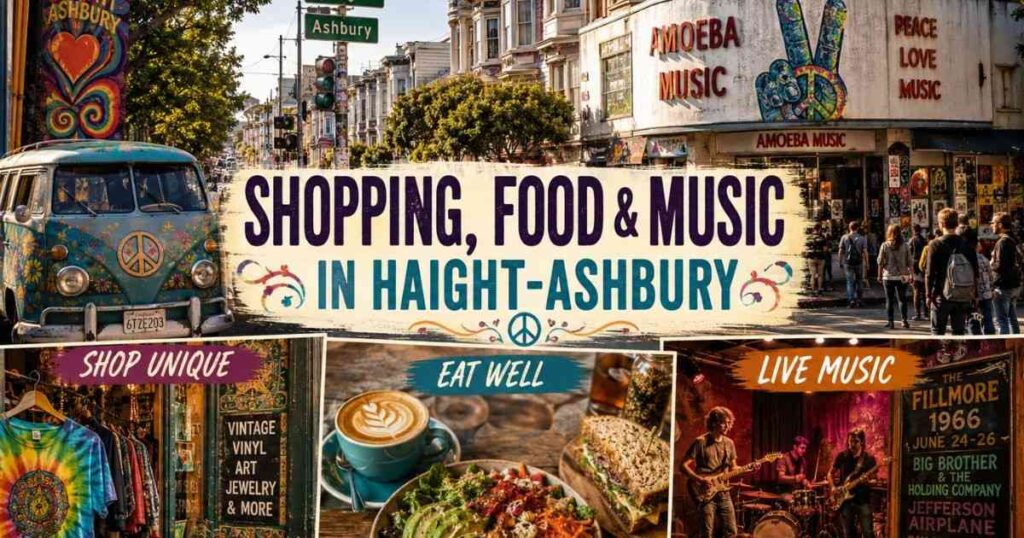
Amoeba Music, at 1855 Haight Street, anchors the shopping scene in Haight-Ashbury San Francisco with one of the largest independent vinyl and CD collections in the country, housed inside a converted 1960s bowling alley. Wasteland and Buffalo Exchange, both on Haight Street, sell secondhand and vintage clothing with prices running $15 to $80 per item depending on the brand. Bound Together Books, a worker-run anarchist bookstore near the corner of Haight and Masonic, has operated since 1976 and stocks titles you won’t find at chain stores. Cha Cha Cha serves Caribbean-inspired tapas a few blocks off Haight Street, with small plates running $8 to $16.
Magnolia Brewing, on Haight near Masonic, pours craft beer flights for $12 to $18 alongside a pub food menu. The Red Victorian, a former hotel turned event space, still displays some of its original psychedelic-era murals inside. Most tourists exploring Haight-Ashbury San Francisco stick to the main Haight Street corridor and skip the residential blocks on Ashbury and Clayton, where the Victorian architecture is arguably more striking than anything on the commercial strip. Weekday afternoons bring noticeably thinner crowds than weekend mornings, when tour buses stack up along Haight Street.
Verdict: Budget two to three hours for Haight Street shopping and food, longer if you plan to browse Amoeba Music’s full catalog.
Best Time to Visit and Pairing with Golden Gate Park
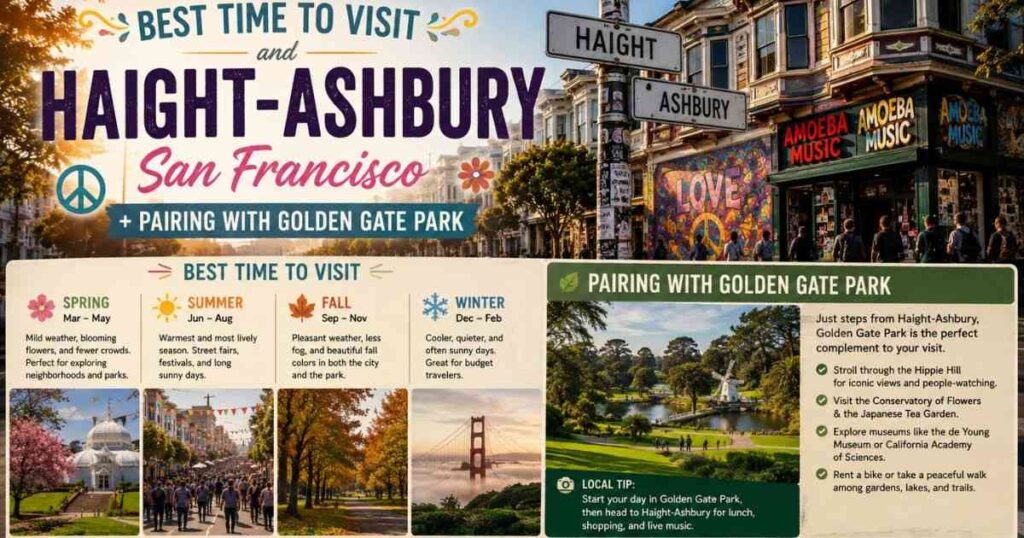
September and October bring San Francisco’s warmest, clearest weather, since the city’s famous fog typically peaks in July and August. Haight-Ashbury San Francisco sits close enough to Golden Gate Park that most visitors combine both into a single afternoon, walking the four blocks west from the Haight Street shops to the park’s eastern edge. Hippie Hill, just inside the park near the Haight Street entrance, hosts informal drum circles most weekend afternoons and remains one of the few spots where the 1960s atmosphere feels unstaged. The California Academy of Sciences and the de Young Museum both sit within a 15-minute walk of the Haight-Ashbury San Francisco border, with adult admission running $30 to $40 each.
Free walking tours of Haight-Ashbury San Francisco run through groups like Free SF Tour on a pay-what-you-wish basis, typically lasting two to three hours and covering roughly 12 blocks. Paid options through GetYourGuide start around $37 for a small-group guided walk with a dedicated local historian. April 20 draws unusually large crowds to Hippie Hill each year, so budget extra time or avoid that specific date if crowds aren’t your priority. Most first-time visitors underestimate how much walking a full Haight-Ashbury and Golden Gate Park day requires, often covering 3 to 4 miles on foot.
Pro Tip: Visit on a Tuesday or Wednesday morning in October to see the neighborhood with roughly half the weekend crowd size.
Practical Tips for Visiting Haight-Ashbury
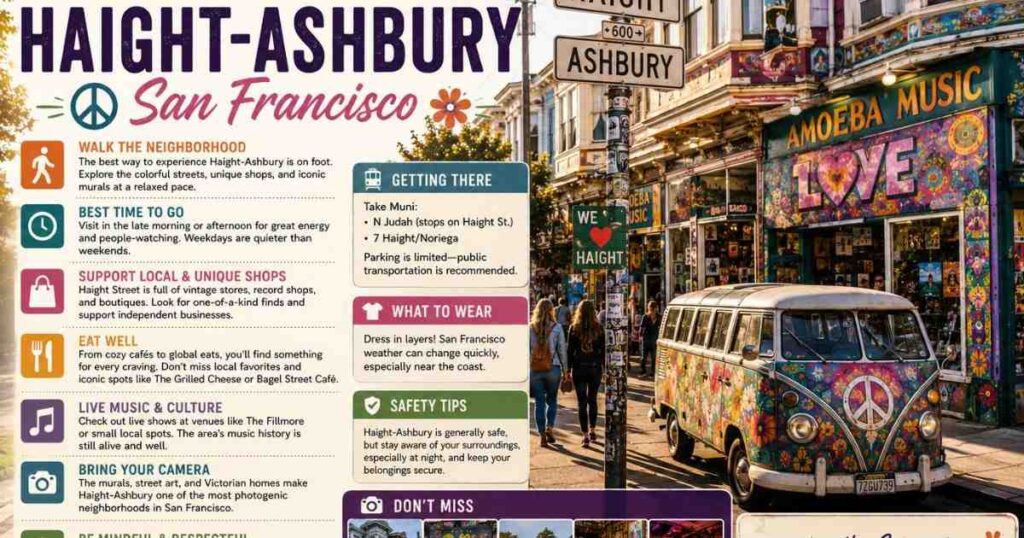
Muni bus lines 6, 7 and 71 all run along or near Haight Street and a single ride costs $2.50 with the Clipper card. Street parking is limited and metered, so a nearby garage running $18 to $28 for a few hours is often easier than circling blocks.
Panhandling and open drug use remain visible on parts of Haight-Ashbury San Francisco, particularly near the Stanyan Street end closest to the park, so keep valuables in a bag rather than an open pocket. Daytime hours, roughly 10 a.m. to 6 p.m., feel noticeably safer and busier than evenings.
Public restrooms are limited to a handful of cafes and the entrance to Golden Gate Park, so plan stops accordingly. Most shops along Haight Street open around 10 or 11 a.m. and close by 7 or 8 p.m., earlier than downtown San Francisco retail hours.
Rideshare pickup in Haight-Ashbury San Francisco can be slow on weekend afternoons due to one-way streets and heavy foot traffic, so build in extra time if you’re catching a flight from SFO afterward. Comfortable shoes matter more here than almost anywhere else in the city, since the best experience comes from walking rather than driving block to block.
Pro Tip: Load a transit app before you arrive, since Muni bus schedules shift often and street parking disappears fast on weekends.
“Planning more California day trips? Our guides on mcway falls big sur and pfeiffer beach big sur cover the rest of the region in detail.”
Frequently Asked Questions
How many days do you need in Haight-Ashbury San Francisco?
Half a day covers the core experience, including the Grateful Dead house, Haight Street shopping and a walk into Golden Gate Park. Music history fans who want to see every counterculture address, including Janis Joplin’s former home and the Red Victorian, should budget closer to a full day. Most visitors pair it with a broader San Francisco itinerary rather than a standalone trip.
Is Haight-Ashbury San Francisco worth visiting?
Yes, it remains one of the few American neighborhoods where a specific cultural movement left a visible, walkable imprint six decades later. The Victorian architecture alone justifies a visit, even without the Summer of Love history layered on top. Most visitors who expect only nostalgia come away surprised by how much of the counterculture identity persists in daily neighborhood life.
What is the best time to visit Haight-Ashbury San Francisco?
September and October offer the clearest skies and mildest temperatures, typically in the 60s and 70s Fahrenheit. Weekday mornings see noticeably fewer tour groups than weekend afternoons throughout the year. Avoid planning a visit around April 20, when crowds at nearby Hippie Hill swell well beyond a typical weekend.
Is Haight-Ashbury San Francisco expensive for tourists?
No, walking the neighborhood itself costs nothing beyond transit and several guided tours run on a pay-what-you-wish basis. Add $20 to $35 for food and $15 to $80 if you shop for vintage clothing or records. A half day covering the walk, lunch and one paid tour typically runs $60 to $90 per person.
Can you do a day trip from downtown San Francisco to Haight-Ashbury?
Yes, Haight-Ashbury San Francisco sits about 15 to 20 minutes from Union Square by car, rideshare or Muni bus. Most visitors combine it with Golden Gate Park, the California Academy of Sciences or the de Young Museum on the same afternoon. No overnight stay is necessary, since the entire neighborhood is walkable in a few hours.
Final Thoughts
Few neighborhoods anywhere let you stand on the exact sidewalk where a cultural movement started and Haight-Ashbury San Francisco still does. The purple Victorian at 710 Ashbury Street, the record bins at Amoeba Music and the drum circles on Hippie Hill all sit within a 20-minute walk of each other. Stand across the street from the Grateful Dead house for five minutes before you move on and picture the block as it looked in the summer of 1967.