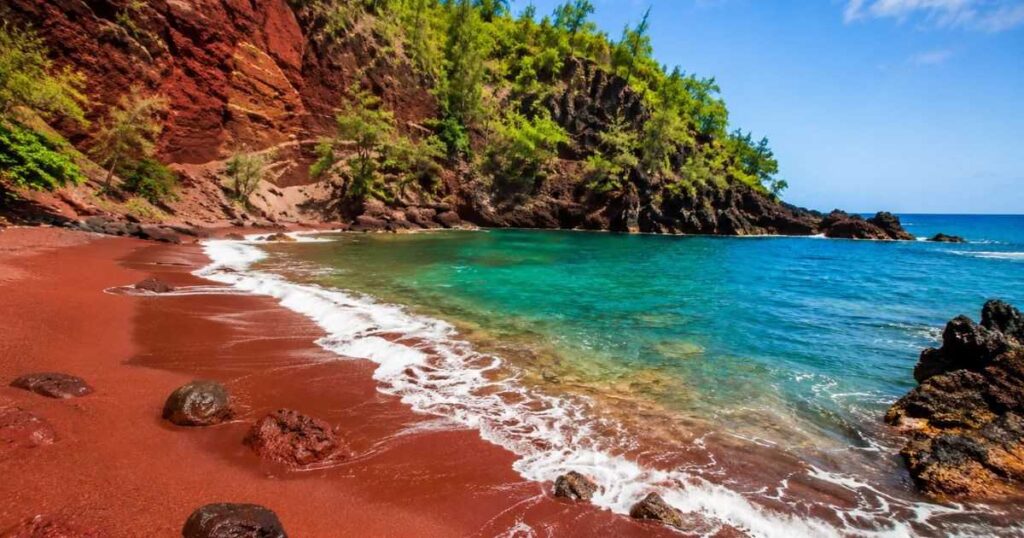
Red Sand Beach Maui sits in a cove that most visitors assume is easy to find, simple to reach and safe to swim at. None of those assumptions hold up. Kaihalulu Beach, the official name requires a narrow trail across eroding cliff-face terrain, has no lifeguards, no restrooms and no dedicated parking and local emergency services have responded to rescues here multiple times. The red sand itself comes from the slow erosion of Ka’uiki Head, an iron-rich volcanic cinder cone that towers above the cove and stains the beach a deep rust-red unlike anything else in Hawaii. This guide gives you every practical detail, trail access, parking, swimming conditions and the three nearby beaches that suit visitors who want the Hana coastline without the risk.
In this guide you will find:
- Exact parking location on Uakea Road and why illegal parking gets cited by Hana police
- Trail conditions as of mid-2026 what “use at your own risk” actually means on the ground
- Honest swimming assessment when the cove is swimmable and when it isn’t
- How Kaihalulu compares to Waiʻānapanapa black sand beach and Hamoa Beach 3 miles south
- The one time of day that gives you red sand beach Maui at its least crowded and most photogenic
Quick Info Box
| Detail | Info |
| Official Name | Kaihalulu Beach — near Hana, East Maui |
| Nearest Airport | Kahului Airport (OGG) — 52 miles / ~2 hours via Road to Hana |
| Entry Fee | Free — no reservation required |
| Trail Length | ¼ mile one way — 10–15 minutes each way |
| Facilities | None — no restrooms, no lifeguards, no showers |
| Best Time to Visit | April–October, mornings before 09:00 |
Red Sand Beach Maui: Location, Trail and How to Get There
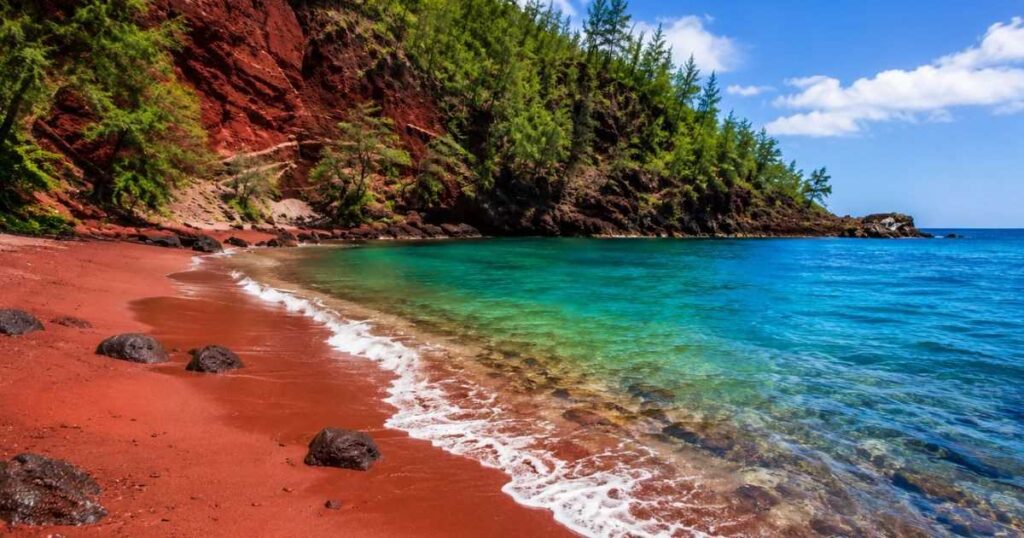
Red sand beach Maui sits just south of Hana town on the island’s east coast, the same stretch of coastline you pass on the Road to Hana. From Kahului, the drive takes approximately 2 hours via the Hana Highway (Route 360). The beach is not signposted. No official marker points to it from the road and Google Maps sometimes routes visitors incorrectly.
The trailhead starts at the end of Uakea Road, near the Hana Community Center and Hana Ballpark. Walk through the yellow gate, cross a small field and follow the narrow dirt path along the cliff edge. The trail covers ¼ mile and takes 10–15 minutes each way at a careful pace. The path runs along a steep eroding cliff face with drop-offs on one side, sections have partially closed and reopened multiple times since 2023 and the condition changes after heavy rain.
The trail passes through private land. Local community groups have repeatedly asked visitors to stay on the established path, avoid disturbing vegetation on the cliff edge and leave no trace. The path is not maintained by any park authority, it exists through informal use rather than official designation. People have been injured here and Hana’s emergency response capacity is limited given its remote location.
Parking on Uakea Road is free but extremely limited. A small number of legal spots sit between the Hana Ballpark and the Community Center. Hana has an active police presence and issues citations for illegal parking, blocking driveways or ignoring no-parking signs. Hana Bay Beach Park (500 m away) offers additional parking when street spots are full.
Pro Tip: Arrive before 08:00 early morning gives you the best chance of legal parking on Uakea Road, the coolest trail conditions and the cove with fewer than 10 other visitors. By 10:00 on clear days, the limited parking fills and the trail becomes congested at its narrow sections.
Red Sand Beach Maui: What You Find at the Cove
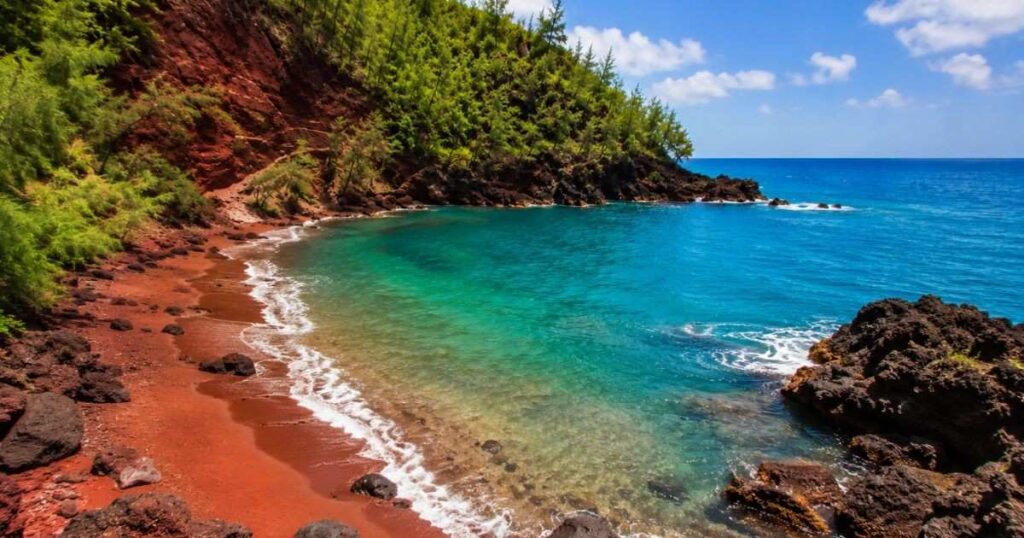
The moment you step onto red sand beach Maui, the color contrast stops people mid-stride. The sand runs a deep rust-red from iron oxide in the eroding Ka’uiki Head cinder cone above. Black lava rock forms a natural barrier wall that extends into the water, partially sheltering the cove from open ocean swells. Turquoise water fills the protected side, the exposed side runs rougher and darker.
The sand texture surprises most visitors it is coarser than typical beach sand, mixed with small pebbles and volcanic fragments. Walking barefoot on the dry upper beach is comfortable, the wet sand near the waterline is firm and dense. The beach runs approximately 150 feet wide at low tide, narrowing significantly at high tide when water reaches the cliff base on the south side.
Swimming at Kaihalulu depends entirely on conditions. The lava rock barrier creates a semi-protected pool on the north side of the cove where the water calms on flat days while snorkeling inside the barrier reaches coral formations with yellow tang butterflyfish and occasional sea turtles. Outside the barrier, currents run unpredictable and surf surges against the rocks without warning. No lifeguard operates here. Local advisories recommend against swimming for casual visitors, particularly families with children or anyone without strong open-water experience.
The beach is clothing optional. This is documented in multiple visitor reports and is relevant for anyone planning a family visit. It comes with the territory of an unregulated, unmonitored cove.
Pro Tip: Bring closed-toe shoes with grip for the trail and change to sandals at the beach. The trail section closest to the cove drops steeply and the soil is loose smooth-soled footwear causing most of the slips that lead to rescues here.
Red Sand Beach Maui vs Nearby Beaches: Honest Comparison
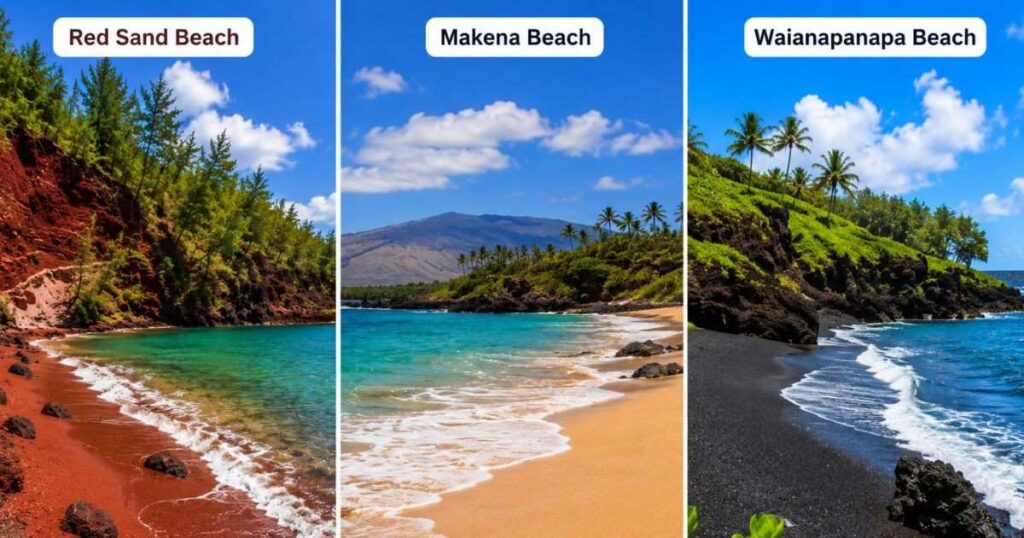
Kaihalulu draws visitors primarily for its visual uniqueness, not for beach functionality. Three beaches within 5 miles of Kaihalulu suit different priorities better.
Waiʻānapanapa State Park (3 miles north of Kaihalulu) holds Maui’s famous black sand beach Pa’iloa Beach along with sea caves, lava tubes, a blowhole and a maintained coastal trail. Entry requires an advance reservation at dlnr.hawaii.gov $5 per person + $10 per vehicle. The park has restrooms, showers, picnic areas and large paved parking. For visitors who want a geologically dramatic Hana-area beach with proper facilities, Waiʻānapanapa is the stronger choice. The black sand against white foam and green naupaka bushes rivals Kaihalulu’s color contrast.
Hamoa Beach sits 3 miles south of Kaihalulu on the same coastline. It is a crescent-shaped bay with soft gray-gold sand, gentle consistent waves suitable for swimming and shade from hala trees at the back of the beach. Entry is free. Restrooms and showers are available. Hamoa ranks among Maui’s most respected swimming beaches on the east side author James Michener called it the most beautiful beach in the Pacific. Parking is limited roadside but more available than Kaihalulu.
Koki Beach, 1 mile south of Kaihalulu, also shows red sand, a wider, more exposed stretch with powerful surf that locals and experienced surfers use. Swimming is unsafe for most visitors but the red sand here is visible, accessible from roadside parking and gives the color experience without the cliff trail. A Huli Huli Chicken food stand across the road from Koki Beach is one of the most-discussed food stops on the Road to Hana.
Verdict: Visit Kaihalulu for the specific cove experience if you are physically confident on steep terrain and visit in morning hours but pair it with Waiʻānapanapa for swimming and Hamoa Beach for a proper beach afternoon.
Practical Tips for Red Sand Beach Maui
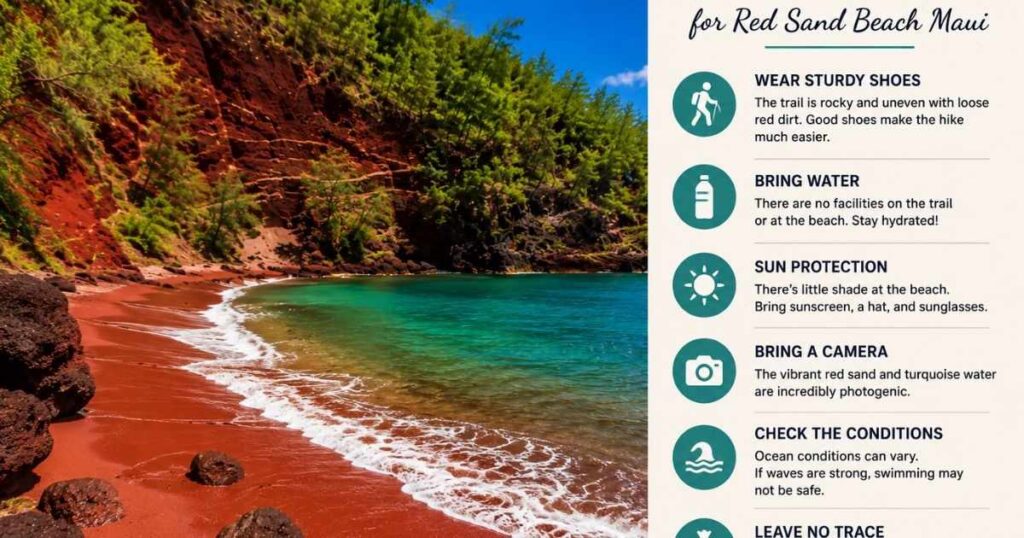
Four details about red sand beach Maui consistently catch first-time visitors off guard. First, the trail is not difficult in dry conditions for fit adults reviewers who describe it as “terrifying” typically arrived unprepared with sandals and no trail experience. Reviewers who describe it as “easy” typically came early in dry weather with proper shoes. The honest assessment: it is a short, exposed trail with genuine consequences if you slip on the eroded sections. Weather changes significantly visit only in dry conditions.
Second, there are zero facilities at the cove. No restrooms, no water, no shade structures, no trash cans. Carry everything in and out. The nearest public restroom sits at Hana Bay Beach Park, 500 m from the trailhead.
Third, the cove holds no phone signal in most sections. Download your maps offline before leaving Hana town and tell someone where you are going if you visit solo.
Fourth, the road trip context matters for timing. Most Road to Hana itineraries reach Hana town between 13:00 and 15:00 this is when Kaihalulu’s parking is most congested and the trail most crowded. Visitors who stay overnight in Hana at Travaasa Hana (from $850/night) or at a vacation rental (from $200/night) can visit red sand beach Maui at 07:00 with the cove nearly empty.
Pro Tip: Check trail conditions at the Hasegawa General Store in Hana town staff give current ground-level information on trail conditions, recent rescues and whether the path has been freshly damaged after rain. It is the best real-time source within walking distance of the trailhead.
“Planning more Hawaii day trips? Our guides on things to do maui cover the rest of the region in detail.”
Frequently Asked Questions
Is Red Sand Beach Maui free to visit?
Red sand beach Maui (Kaihalulu Beach) is free to visit with no reservation or entry fee required. The trail passes through private land but is informally accessible to visitors who stay on the path. There are no fees, no ticketing and no booking system unlike nearby Waiʻānapanapa State Park which charges $5 per person plus $10 per vehicle and requires advance reservation at dlnr.hawaii.gov.
Is Red Sand Beach Maui worth visiting?
Red sand beach Maui is worth visiting for the specific visual experience. It delivers a rust-red coved beach formed by volcanic iron erosion, unlike any other beach in Hawaii. The caveat is access: the trail requires closed-toe shoes, dry conditions and physical confidence on narrow terrain. Visitors who arrive unprepared or in wet weather regularly find the trail more challenging than expected. For visitors prioritizing swimming and facilities, Hamoa Beach 3 miles south is the stronger choice.
What is the best time to visit Red Sand Beach Maui?
Early mornings between 07:00 and 09:00 give the best experience at Kaihalulu. Parking on Uakea Road fills after 09:30 on clear days and the narrow trail sections become congested when multiple groups pass simultaneously. April through October delivers the most stable dry conditions for the trail, with lower rainfall probability than the wetter winter months. Morning light from the east also hits the cinder cone cliff directly, intensifying the red color contrast against the water.
How hard is the trail to Red Sand Beach Maui?
The trail is short ¼ mile, 10–15 minutes but has narrow exposed sections with drop-offs that require attention. It is not suitable for young children, elderly visitors with mobility concerns or anyone wearing sandals or smooth-soled shoes. In dry conditions with proper footwear, most fit adults complete it without difficulty. After rain, the eroding clay-soil sections become genuinely slippery and several community guides recommend avoiding the trail entirely until it dries.
Is Red Sand Beach better than Waiʻānapanapa Black Sand Beach?
Red sand beach Maui and Waiʻānapanapa serve different purposes. Kaihalulu is a free, facility-free cove with a challenging trail and no swimming lifeguards best for adventurous visitors wanting a unique visual experience. Waiʻānapanapa charges $5 per person plus $10 per vehicle but provides restrooms, showers, a maintained black sand beach, sea caves and a coastal hiking trail. For families, first-time Hawaii visitors or anyone who wants a proper beach day in the Hana area, Waiʻānapanapa is the stronger practical choice. If you have time for both on the same Road to Hana day, visit Waiʻānapanapa first (it requires a reservation) and Kaihalulu second.
Conclusion
Red sand beach Maui earns its reputation as one of the most visually distinct beaches in the entire Pacific, the rust-red iron sand, the black lava sea wall, the turquoise protected water and the cinder cone cliff above it exist nowhere else in Hawaii. The trail is short but unforgiving in wet conditions and the cove has no facilities of any kind. Arrive at the Uakea Road trailhead at 07:30 on a clear morning in May, wear closed-toe shoes, take 15 minutes down the cliff path and stand at the water’s edge when the early light hits Ka’uiki Head directly the color the cliff throws onto the sand at that hour is the image that defines this beach.