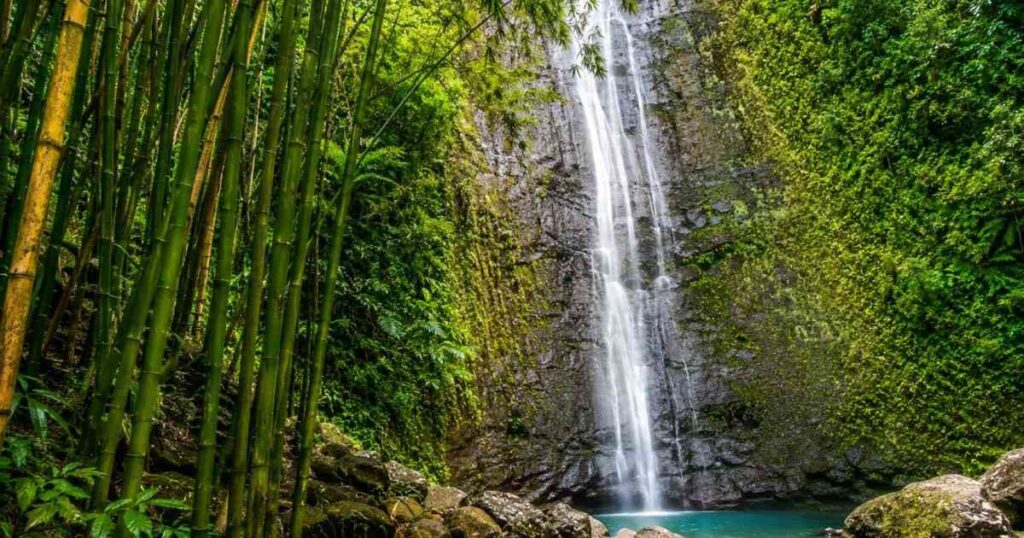
Most tourists picture Oahu as beaches, surfboards and Waikiki sunsets. Lulumahu Falls flips that image completely, you are in a dense bamboo forest, crossing a rocky stream and standing under a 50-foot cascade, all within 30 minutes of downtown Honolulu. The contrast is that sharp. This trail sits just off the Pali Highway in Nuuanu Valley, yet it feels nothing like the crowded tourist circuit. In this guide, you will find everything you need to plan a safe, successful hike to Lulumahu Falls from the permit process to parking warnings, trail navigation tips and the best months to go.
In This Guide You Will Find:
- How to get the $2.50 state permit before you hike (required by Hawaii DLNR)
- Exact parking location off Pali Highway and the serious car break-in risk you must know
- Trail breakdown stream crossings, bamboo section and the route hikers most often get wrong
- Why Lulumahu Falls flows year-round while most other Oahu waterfalls dry up in summer
- Best time of day to arrive so you have the falls to yourself
- What to pack and what NOT to wear on this trail
Quick Info Box
| Detail | Info |
| Location | Nuuanu Valley, off Pali Highway (HI-61), Honolulu, Oahu |
| Nearest Airport | Daniel K. Inouye International Airport (HNL) — 11 miles / 25 min drive |
| Best Time to Visit | April to October (dry season, drier trail conditions) |
| Travel Time from Waikiki | 8 miles / 20–30 minutes by car |
| Days Recommended | Half day (2–3 hours total with drive) |
| Average Daily Cost | $2.50 permit + $10–15 parking + $15–20 lunch nearby = ~$30 per person |
How to Get the Lulumahu Falls Permit (Required Before You Hike)
Lulumahu Falls sits inside the Honolulu Forest Reserve, a restricted watershed managed by Hawaii’s Department of Land and Natural Resources (DLNR). You need a permit to hike legally and getting one is simple. Head to trails.ehawaii.gov and book online. The processing fee is $2.50 per group and one permit covers up to 5 people. The state releases 100 permits per day, so availability is rarely a problem. You can usually grab a slot just a few days before your hike, so there is no need to plan months in advance.
Without a permit, you are technically trespassing on state watershed land. Rangers do patrol the area and signage near the trailhead clearly marks it as a restricted zone. Skipping the permit to save $2.50 is not worth the risk. There is also a T-intersection partway along the trail where the right-hand path leads to the Kaniakapupu Ruins, a protected historic site where first-time trespassers face a $10,000 fine. Always go left at that fork.
Pro Tip: Book your permit the night before your hike. Check availability early in the morning if your preferred date is close, slots get taken by 9am on popular weekends.
Getting to Lulumahu Falls and the Parking Situation
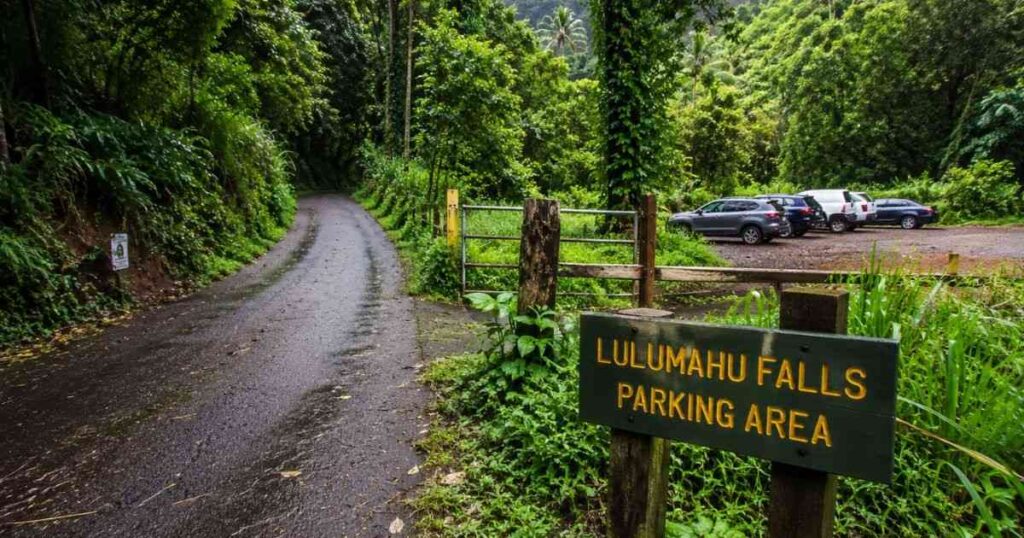
The trailhead sits off Pali Highway (HI-61), near the intersection with Nuuanu Pali Drive, roughly 8 miles from Waikiki. The drive takes 20–30 minutes depending on traffic. You will spot a small dirt parking area on the side of the road cars packed haphazardly are your signal you are in the right place.
Here is the warning you must take seriously: this parking lot is a well-known crime hotspot. Break-ins are frequent. Locals who hike here regularly have seen broken glass on the ground consistently. Thieves target this spot because they know hikers will be gone for at least two hours. Do not leave anything inside your car not a bag, not a phone charger, not sunglasses on the seat. Empty the car completely before you start walking. If you rent a car, pop the trunk open and leave it visibly empty. Some hikers choose to arrive by rideshare to eliminate the parking risk entirely. The ride from Waikiki costs around $20–25 each way via Uber or Lyft.
Pro Tip: Arrive by 7:00–7:30 AM. You get the trail to yourself, the mud is firmer in cooler morning air and you avoid the mid-morning crowds that pack the trail by 10 AM.
The Lulumahu Falls Trail What to Expect Step by Step
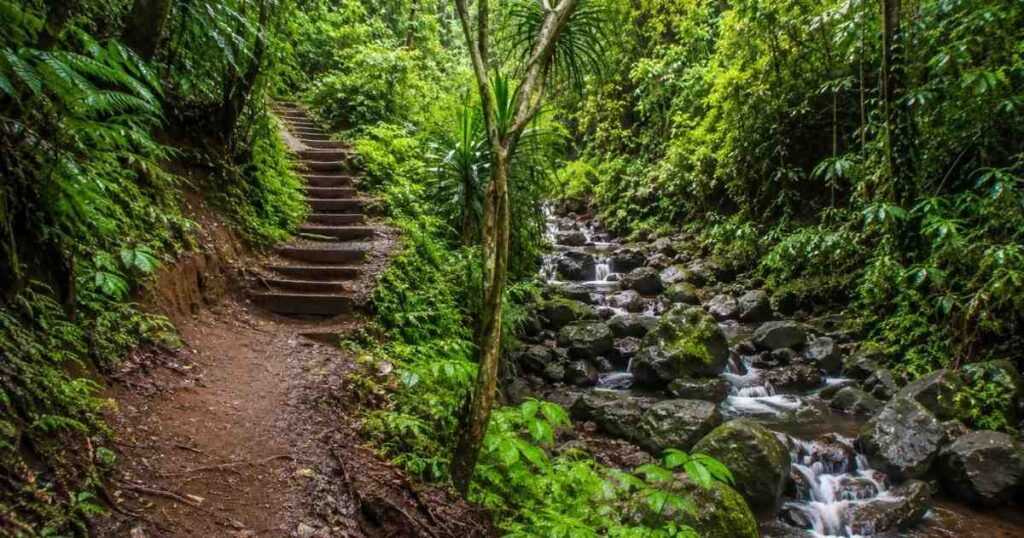
The hike is 1.7 miles out and back with roughly 200 feet of elevation gain. Most hikers complete the round trip in 1.5 to 2 hours. The difficulty rating is moderate, it is not a summit challenge but it is not a beach stroll either.
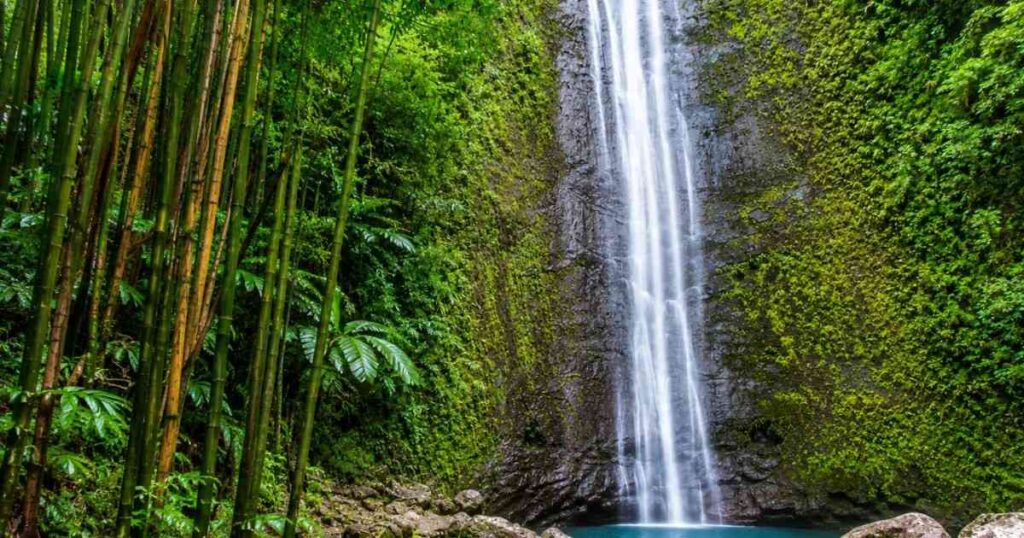
The trail starts as a wide dirt service road through towering bamboo. The sound of bamboo creaking in the wind hits you immediately, it is one of the most memorable parts of the hike. After about 0.3 miles you reach the Nu’uanu Reservoir, where the path opens up to views of the Ko’olau Mountain Range and the green valley. Stay on the service road past the reservoir, then look for the trail entering the forest on your left. From here the trail follows a stream upward through dense jungle. You will cross the stream 3–4 times on rocks and boulders wear shoes with grip, not sandals or flip flops. The final section narrows and gets muddier. You hear Lulumahu Falls before you see it. The cascade drops 50 feet into a small pool at the base in person, it looks considerably larger than photos suggest.
Pro Tip: Download the AllTrails map for this hike before you leave your hotel. The trail has no official signage and off-route detours are common. Pink ribbons tied to trees mark the correct path and follow them closely.
Best Time to Visit Lulumahu Falls and Trail Conditions
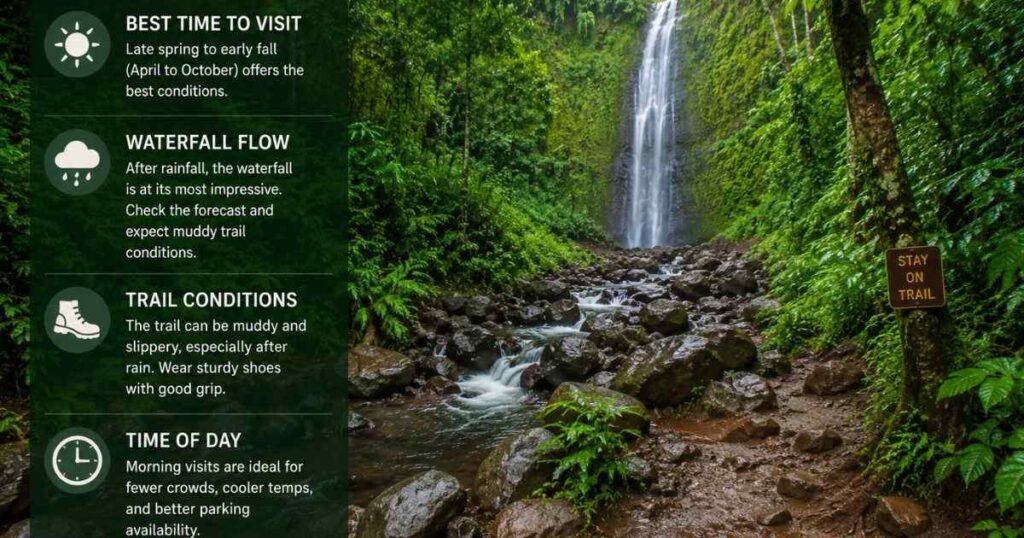
One of the biggest advantages of Lulumahu Falls over other Oahu waterfalls is that it flows year-round. Unlike Manoa Falls, which depend heavily on recent rainfall, Lulumahu Falls draws water from high in the Ko’olau Mountains above Pu’u Konahuanui, the tallest peak in the range. The water supply is constant regardless of seasonal rain patterns. This makes it one of the most reliable waterfall hikes on the island.
That said, trail conditions vary significantly by season. April through October is the dry season and delivers firmer ground, less mud and safer stream crossings. November through March brings heavier rain to the windward side of Oahu. The trail becomes ankle-deep mud in sections after significant rain. The stream crossings also run faster and deeper in winter. If you visit between December and February, check the weather forecast the night before and delay by a day if heavy rain is expected.
The best time of day is early morning, between 7:00 and 8:30 AM. The falls sit in a narrow gulch and receive direct sunlight only for limited windows. Late afternoon visits can put the sun partially on the falls, reducing the visual impact. Early morning light filters through the bamboo and jungle canopy in a way that afternoon visits simply cannot match.
Pro Tip: Visit on a weekday in May, June or September for the ideal combination of dry conditions, manageable crowds and full water flow at the falls.
Lulumahu Falls vs. Manoa Falls Which Hike Should You Choose?
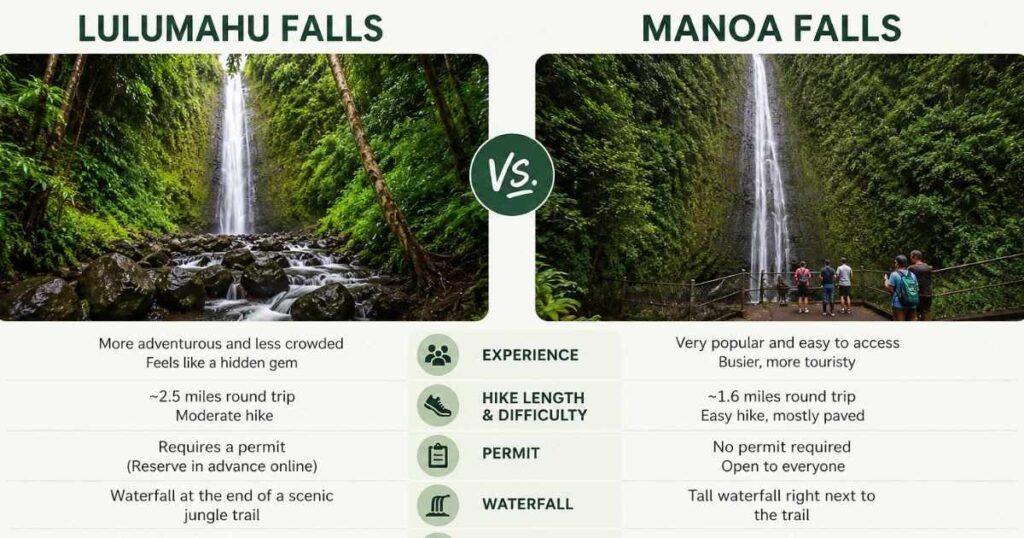
Manoa Falls is the most-visited waterfall hike on Oahu, sitting about 4 miles from Waikiki in Manoa Valley. It charges a $5 parking fee and requires no permit. Lulumahu Falls costs $2.50 for a group permit, has a riskier parking situation and is harder to navigate without a map. So why choose Lulumahu Falls?
The answer is the experience itself. Manoa Falls receives thousands of visitors per week on a busy day the trail feels like a queue. Lulumahu Falls is capped at 100 permits daily, which keeps the crowd manageable. The trail also offers more variety: bamboo forest, open reservoir views, stream crossings and a jungle scramble, all in 1.7 miles. Manoa Falls is a straightforward out-and-back path through forest. Both waterfalls drop approximately 50 feet but the setting at Lulumahu feels wilder and less manicured.
If you have a child aged 5 or above in good walking condition, both hikes are doable. Lulumahu Falls is slightly more physical due to the stream crossings. For a single waterfall hike on Oahu, Lulumahu Falls gives a more complete jungle adventure. If ease and accessibility matter most, Manoa Falls is the simpler choice.
Verdict: Choose Lulumahu Falls for a genuine jungle experience with fewer crowds. Choose Manoa Falls if you are short on time or hiking with very young children.
“Planning more Hawaii day trips? Our guides on things to do maui and red sand beach maui cover the rest of the region in detail.”
Frequently Asked Questions
How long does it take to hike Lulumahu Falls?
The round trip takes 1.5 to 2 hours for most hikers. The trail is 1.7 miles out and back with roughly 200 feet of elevation gain. Add 30 minutes if you spend time at the base of the falls or stop to photograph the bamboo forest section.
Is Lulumahu Falls worth visiting?
Yes, Lulumahu Falls is one of the most rewarding short hikes on Oahu for the variety it packs into 1.7 miles. You walk through bamboo, past a reservoir, along a jungle stream and reach a 50-foot waterfall. The $2.50 permit fee is minimal and the 100-person daily cap keeps the experience far less crowded than Manoa Falls.
What is the best time to visit Lulumahu Falls?
The best time is early morning from April to October. April through October is the dry season, giving firmer trail conditions and less mud. Arrive by 7:00–8:00 AM to get the falls to yourself before the trail fills up. Lulumahu Falls flows year-round, so even dry summer months guarantee a full cascade.
Do you need a permit for Lulumahu Falls?
Yes, a Hawaii DLNR permit is required. Book online at trails.ehawaii.gov. The processing fee is $2.50 per group and covers up to 5 people. The state issues 100 permits per day and reservations can usually be made just 1–2 days before your hike.
Can you swim at Lulumahu Falls?
The pool at the base of Lulumahu Falls is shallow and small, it is not a deep swimming hole. Many hikers wade in to cool off and wearing a swimsuit under your clothes is worth it. Do not attempt to swim or play in the stream during or immediately after heavy rain, as water levels and current speed increase rapidly.
Conclusion
Lulumahu Falls earns its place on any serious Oahu hiking list. It is not just a waterfall, it is bamboo forest, mountain reservoir, jungle stream crossings and a 50-foot cascade all compressed into under two hours from Waikiki. The $2.50 permit is the best value on the island. Book it at trails.ehawaii.gov the night before, empty your car completely before you start walking, download the AllTrails map and wear hiking shoes with real grip. Arrive at the trailhead by 7:00 AM on a dry weekday in May or June you will reach Lulumahu Falls with mud on your boots, quiet in the valley and the whole cascade to yourself.